
Muse Wonder vs Claude Opus 5.5 vs Gemini 4 Argon: Which Model to Build On
By Faisal Khan
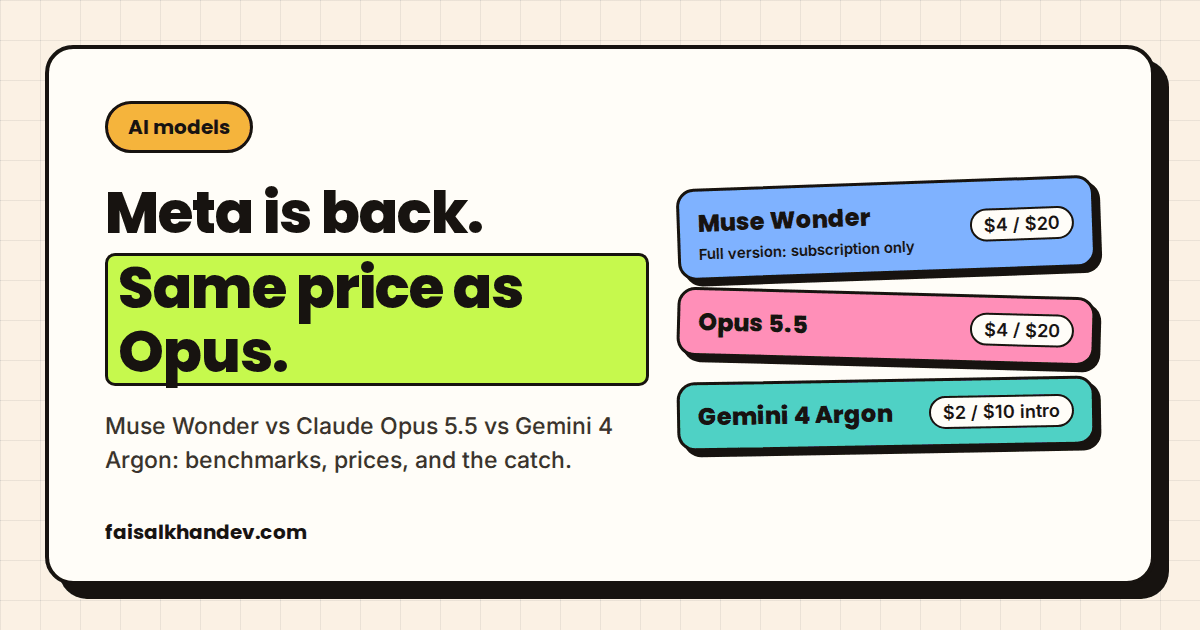
Meta is back in the frontier race. On October 12 it launched Muse Wonder, a model built for AI agents that remember what matters and keep working on hard tasks. The day after, Google opened Gemini 4 Argon to paying developers. So for the first time in a while, there are three serious models you can build on at roughly the same price.
I pick models for client AI agents and coding tools, so I read Meta's full benchmark table rather than the launch headline. My take on Muse Wonder vs Claude Opus 5.5 vs Gemini 4 Argon: Muse Wonder matches Opus 5.5 on price and beats it on long coding marathons, but the version that wins those benchmarks isn't on the API. Opus still wins the work most agents actually do.
I haven't used Muse Wonder yet, so everything about it below comes from Meta's published numbers, not my own testing. Opus 5.5 and Gemini 4 Argon I have used a lot.
What is Meta Muse Wonder?
Muse Wonder is Meta's most capable AI model as of October 2026, built for personal and professional AI agents that carry context across conversations and keep working through long, difficult tasks. Muse Wonder comes in two versions: standard Muse Wonder on Meta's API, and the stronger Muse Wonder Full for Muse Code subscribers.
Meta's launch post names two features. Active Memory carries important context about you across conversations and pulls back the details a task needs. Active Focus keeps the model working on a hard goal: trying other approaches, working through blockers, and checking in before important actions. Meta also says Muse Wonder will soon power its consumer Muse app, rolling out to subscribers first.
Two things worth knowing up front. Muse Wonder is a model, not an agent product you sign up for, so it's closer to Opus 5.5 than to something like ChatGPT Dots. And it isn't open: MarkTechPost's launch breakdown notes no parameter count, no open weights and no full safety report yet. Meta says the safety report is coming.
Muse Wonder vs Opus 5.5 benchmarks: what Meta's numbers show
Muse Wonder Full beats Claude Opus 5.5 on Meta's long-running coding tests, and Opus 5.5 beats Muse Wonder Full on terminal work, program building, computer use and overall intelligence. The standard Muse Wonder you can call through the API trails Opus on most rows.
These are the coding and agent rows from Meta's model card, as reproduced by MarkTechPost (I couldn't load Meta's card directly, so I'm citing the copy I could open):
- SWE-Marathon (long software projects): Wonder Full 57.5, Wonder 53.1, Opus 5.5 46.3, GPT-6 Astra 42.5.
- DeepSWE 1.1: Wonder Full 79.0, Wonder 78.8, Opus 5.5 74.2, Astra 74.1.
- Terminal-Bench 4.0 (Artificial Analysis harness): Opus 5.5 59.6, Astra 59.1, Wonder Full 57.1, Wonder 52.0.
- ProgramBench: Opus 5.5 70.5, Wonder Full 59.0, Astra 52.5, Wonder 50.0.
- Artificial Analysis Intelligence Index v4.3: Opus 5.5 58, Wonder Full 56, Astra 53, Wonder 52.
Read the fine print before you get excited about SWE-Marathon. Per MarkTechPost, Meta's model card says competitor runs were "best-effort" and may not be tuned, and the rival scores on SWE-Marathon came from Codex and Claude Code rather than one shared test setup. Meta also ran Wonder Full at a higher effort setting for that row. A big win on a benchmark you designed, measured on your own harness, is the weakest kind of win.
Gemini 4 Argon isn't in Meta's table at all. The closest like-for-like number is Terminal-Bench 4.0 on the same Artificial Analysis harness, where OpenRouter's Argon listing shows 57.1%, level with Wonder Full. Google's own launch numbers for Argon are in my Gemini 4 Argon vs Opus 5.5 vs GPT-6 Astra comparison.
The Muse Wonder Full catch
The Muse Wonder that wins Meta's headline benchmarks is not the one developers can buy per token. Muse Wonder Full is only available inside Meta's Muse Code tool, on the Power plan at $50 a month or the Maximum plan at $200 a month, according to MarkTechPost's write-up of Meta's pricing.
That matters a lot if you're building a product. An AI agent inside your app calls a model through an API, billed per token. Through the API, you get standard Muse Wonder. And on Meta's own table, standard Wonder scores 52.0 on Terminal-Bench against Opus 5.5's 59.6, and 50.0 on ProgramBench against 70.5.
So the honest comparison for a builder is standard Muse Wonder vs Opus 5.5. On that pairing, Opus wins terminal work, ProgramBench and the overall index, while Wonder leads DeepSWE and SWE-Marathon.
If you're a developer who just wants the strongest coding assistant in a terminal, the $50 Muse Code plan is a different question, and a fair one to test. It's the same choice I walked through in Claude Code vs Cursor vs Copilot: try the tool on your own repo for a week.
What Active Memory means for an AI agent
Active Memory matters if your agent works with the same person or account over weeks, and matters much less for one-off tasks. A support agent that remembers a customer's past orders, or an assistant that remembers how a sales manager likes reports formatted, gets better with memory. A script that classifies today's invoices doesn't.
Meta's evidence here is MemoryBench, an internal Meta test. On it, Wonder (85.6) and Wonder Full (85.5) lead Opus 5.5 (81.5). Internal benchmarks aren't worthless, but nobody outside Meta can check them yet.
And there's a practical point. Memory doesn't have to live in the model. In the internal chatbot I built for a distributor's ERP, the assistant reads live stock straight from the business's own database instead of remembering it. Data kept that way stays auditable, deletable and portable between models. A model that's good at using retrieved context is helpful. A model that holds your customer's context in someone else's system is a question your legal team will ask about.
Muse Wonder vs Claude Opus 5.5 vs Gemini 4 Argon: side-by-side
Claude Opus 5.5 is the safest default for agents that run tools and terminals, Muse Wonder is the newcomer to test on long multi-file coding work, and Gemini 4 Argon is the cheapest of the three right now.
| Muse Wonder | Claude Opus 5.5 | Gemini 4 Argon | |
|---|---|---|---|
| Maker | Meta | Anthropic | |
| API price per 1M input / output tokens | $4 / $20 | $4 / $20 | $2 / $10 introductory, $4 / $20 standard |
| Strongest version on the API? | No, Wonder Full is Muse Code only | Yes | Yes |
| Terminal-Bench 4.0 (Artificial Analysis) | 52.0 (Wonder Full 57.1) | 59.6 | 57.1 |
| Open weights | No | No | No |
| Best fit | Long multi-file coding, agents that need memory | Tool-using and terminal agents | Cost-sensitive builds during the discount |
Prices are from OpenRouter's Muse Wonder listing, Claude's API pricing page and OpenRouter's Argon listing. Benchmark scores are vendor-reported unless marked otherwise.
Muse Wonder cost vs Opus 5.5 and Argon
Muse Wonder costs $4 per million input tokens and $20 per million output tokens, exactly the same as Claude Opus 5.5. Gemini 4 Argon lists at the same $4 and $20 but currently sells at half that, $2 and $10, during Google's introductory offer.
Take one agent task that reads 200,000 tokens and writes 20,000, with no caching:
- Muse Wonder: $0.80 in + $0.40 out = $1.20
- Claude Opus 5.5: $0.80 + $0.40 = $1.20
- Gemini 4 Argon (introductory): $0.40 + $0.20 = $0.60
Same price means the decision is about results, not the bill, at least between Wonder and Opus. Argon's discount is real money at scale, but plan for it ending. I go through caching and the other pricing traps in what it costs to run an AI feature in production.
How to choose between Muse Wonder, Opus 5.5 and Argon
- Decide what your agent mostly does. Running tools, commands and checks points to Opus 5.5. Long multi-file coding points to testing Muse Wonder.
- Compare the version you can actually buy. For an app, that's standard Muse Wonder on the API, not Wonder Full.
- Run 20 real tasks on each. Use your own tickets, documents or customer questions. Vendor tables measure their tests, not yours.
- Count cost per finished task. A model that needs two attempts costs double, whatever its token price.
- Keep memory in your own database. Then switching models later is a config change, not a migration.
- Put the model behind one function. One adapter, one setting. When the next launch lands, you test it in an afternoon.
That last step is how I build every custom AI agent for clients: the model is a swappable part, and the business logic, data and approval rules stay put.
Is Muse Wonder better than Claude Opus 5.5?
Muse Wonder is better than Claude Opus 5.5 on long-running coding tests in Meta's own table, but Opus 5.5 leads on terminal work, program building, computer use and the Artificial Analysis Intelligence Index. Through the API, standard Muse Wonder trails Opus on most of those rows.
Can I use Muse Wonder Full through the API?
No. Meta offers Muse Wonder Full only inside its Muse Code tool, on the Power plan at $50 a month or the Maximum plan at $200 a month. Developers calling the Meta Model API get standard Muse Wonder, which scores lower than Wonder Full on most of Meta's published benchmarks.
Is Muse Wonder open source?
No. Muse Wonder is a closed model that runs only on Meta's cloud, through the Meta Model API or Muse Code. Meta has not published open weights or a parameter count, and its full safety report is still to come. If you need a model you can host yourself, Muse Wonder isn't it.
Is Gemini 4 Argon available to developers now?
Yes. Gemini 4 Argon is now on sale through Google AI Studio and Vertex AI, after an earlier limited testing phase. It currently costs $2 per million input tokens and $10 per million output tokens under an introductory discount, against a standard price of $4 and $20.
Where to start
Muse Wonder vs Claude Opus 5.5 vs Gemini 4 Argon comes down to this: same price for Wonder and Opus, a temporary discount for Argon, and no clear winner outside your own tests. Build on Opus 5.5 if your agent lives in tools and terminals, test Muse Wonder on long coding work, and keep the model swappable. If you want help picking or wiring the model, get in touch.