
Gemini 4 Argon vs Claude Opus 5.5 vs GPT-6 Astra for Coding
By Faisal Khan
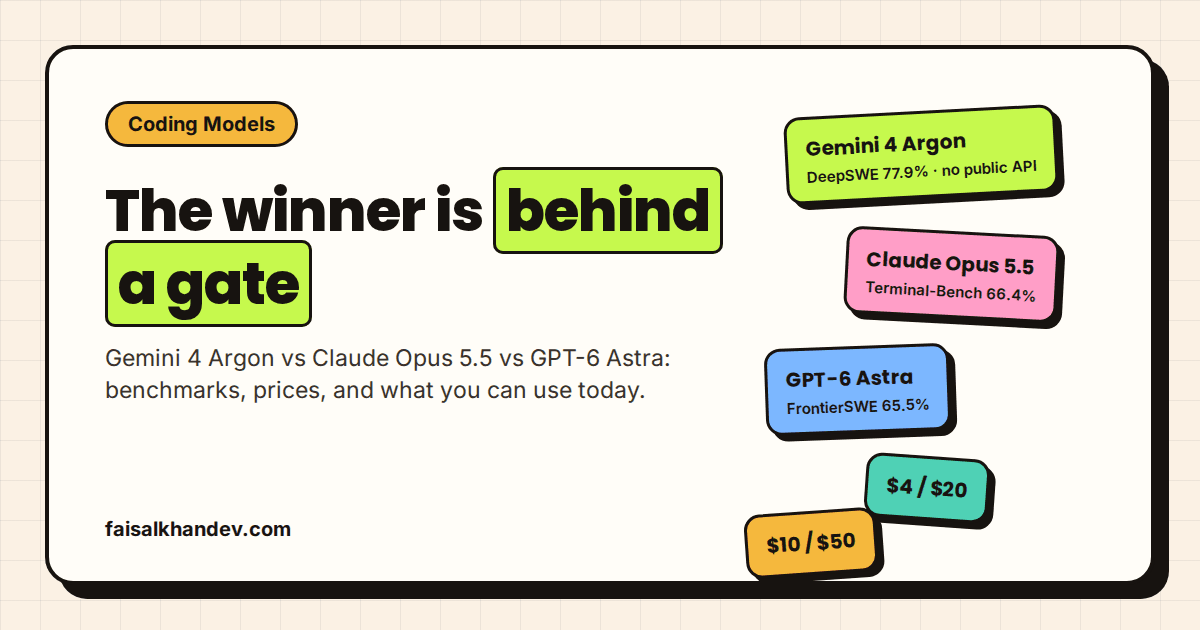
Google finally shipped Gemini 4, and the headline number is a coding one. On September 30, Google announced Gemini 4 Argon with a record 77.9% on DeepSWE v1.1, ahead of Claude Opus 5.5 and GPT-6 Astra. Then came the catch: almost nobody can use it yet.
I pick models for client AI features and coding agents, so I read the whole benchmark table instead of the headline. My verdict on Gemini 4 Argon vs Claude Opus 5.5 vs GPT-6 Astra for coding: Argon wins the most tests, Opus 5.5 still wins the terminal work that coding agents actually do, and the only two you can build on today are Opus and Astra.
What are Gemini 4 Argon, Claude Opus 5.5 and GPT-6 Astra?
Gemini 4 Argon, Claude Opus 5.5 and GPT-6 Astra are the flagship AI models from Google, Anthropic and OpenAI as of October 2026, each built for long, complex work such as coding agents, research and multi-step tasks. Gemini 4 Argon is the newest of the three and the only one without public access.
Gemini 4 Argon was announced on September 30, 2026, in Google's launch post. Google pitches it for software engineering, enterprise knowledge work and cyber defence. Its output limit jumps to 1 million tokens, up from 64K, so it can write a very large amount of code in one task. It arrived late: per AFP via Khaleej Times, Google dropped its planned Gemini 3.5 Pro after months of delays.
Claude Opus 5.5 is Anthropic's top model, released in September 2026, and it's the strongest Claude you can call through the API today.
GPT-6 Astra is OpenAI's flagship. It powers ChatGPT Dots, and OpenAI's cheaper GPT-6.1 Sol now gets close to it. I compared those two in GPT-6.1 Sol vs GPT-6 Astra.
Is Gemini 4 Argon really the best coding model in 2026?
Gemini 4 Argon is the best coding model on some tests, not all of them, and every figure so far comes from Google itself. Argon leads DeepSWE v1.1 and Vibe Code Bench, but trails Claude Opus 5.5 on Terminal-Bench 4.0 and trails GPT-6 Astra on FrontierSWE v2.
LLM Stats' breakdown of Google's table has the full rows. Argon leads 13 of 19 benchmarks and ties one. But the coding rows are split:
- DeepSWE v1.1: Argon 77.9%, Opus 5.5 74.2%, Astra 74.1%.
- Terminal-Bench 4.0: Opus 5.5 66.4%, Astra 58.2%, Argon 57.4%.
- FrontierSWE v2: Astra 65.5%, Opus 5.5 62.3%, Argon 55.0%.
- Vibe Code Bench: Argon 91.9%, Opus 5.5 90.3%, Astra 89.6%.
That fits AFP's line that Argon "remained behind on certain other metrics, including two of the four coding-related benchmarks." Google's own spokesperson was careful too, calling it "comparable to frontier models" like Astra and Opus on key coding benchmarks. That's not how you talk about a clear winner.
There's also no independent check yet. Trending Topics notes "there are no independent tests yet," and points out how much setup matters: Artificial Analysis measured Opus 5.5 at 59.6% on Terminal-Bench, against the 66.4% Anthropic reported. A seven-point swing from the test harness alone is bigger than most of the gaps in the table.
Which benchmark matters most for real coding work?
Terminal-Bench is the benchmark closest to how coding agents actually work, because it tests a model running commands, reading output and fixing its own mistakes inside a real terminal. DeepSWE and FrontierSWE measure long software engineering tasks, which matter more for big, unsupervised refactors.
Here's how I read it. If you're building a coding agent that runs tests, installs packages and retries on failure, weight Terminal-Bench. That's Opus 5.5's lead. If you need a model to plan and finish a long task across a large codebase, DeepSWE matters more, and that's where Argon shines. Tools like Claude Code, Cursor and Copilot all lean on that first kind of work, which I covered in Claude Code vs Cursor vs Copilot.
Honestly, the best benchmark is your own repo. Twenty real tickets from your backlog will tell you more than any of these rows.
Gemini 4 Argon vs Claude Opus 5.5 vs GPT-6 Astra: side-by-side
Claude Opus 5.5 is the strongest choice you can actually buy for terminal-style coding agents today, GPT-6 Astra leads on FrontierSWE and computer use, and Gemini 4 Argon leads the most benchmarks but isn't on sale. Here's the comparison that decides a build.
| Gemini 4 Argon | Claude Opus 5.5 | GPT-6 Astra | |
|---|---|---|---|
| Maker | Anthropic | OpenAI | |
| Can you use it today? | No, Fairwind Program cyber defenders only | Yes, API and Claude plans | Yes, API and ChatGPT plans |
| Price per 1M input / output tokens | $2 / $10 introductory, then $4 / $20 (announced) | $4 / $20 | $10 / $50 |
| DeepSWE v1.1 | 77.9% | 74.2% | 74.1% |
| Terminal-Bench 4.0 | 57.4% | 66.4% | 58.2% |
| FrontierSWE v2 | 55.0% | 62.3% | 65.5% |
| Best fit | Long tasks, huge outputs, once released | Coding agents that live in a terminal | Long engineering tasks and computer use |
Benchmark figures are from Google's launch table, so treat them as vendor-reported.
How much do Gemini 4 Argon, Opus 5.5 and Astra cost?
Gemini 4 Argon is announced at $2 per million input tokens and $10 per million output tokens for an introductory period, rising to $4 and $20 afterwards. Claude Opus 5.5 costs $4 and $20. GPT-6 Astra costs $10 and $50, the most expensive of the three by a wide margin.
The Argon price is from Google's launch post, with cached input 95% off. Google doesn't say how long the introductory period lasts, and you can't actually pay it yet. LLM Stats notes Argon wasn't listed on the Gemini API pricing pages as of October 7. Opus 5.5 pricing is on Claude's pricing page, with cache reads at $0.20 per million. Astra's $10 and $50 is on OpenRouter's GPT-6 Astra listing.
To make that concrete, take one coding-agent task that reads 200,000 tokens of code and writes 20,000 tokens back, with no caching:
- Argon (introductory): $0.40 in + $0.20 out = $0.60
- Opus 5.5, or Argon after the offer: $0.80 + $0.40 = $1.20
- Astra: $2.00 + $1.00 = $3.00
Run that a few thousand times a month and the gap is real money. Caching changes it a lot, though, because coding agents re-read the same files constantly. My post on what it costs to run an AI feature in production goes deeper on that.
How to choose a coding model right now
Choose between the models you can actually call today, test them on your own code, and design so a better model can be swapped in later. Six steps cover it.
- Drop Argon from this month's decision. It has no public API and no date. Plan around Opus 5.5 and Astra, plus cheaper options like GPT-6.1 Sol.
- Pull 20 real tasks from your backlog. Bug fixes, small features and one painful refactor. Benchmarks don't know your codebase.
- Run each model through the same harness. Same tools, same prompts, same effort setting. The test setup alone moved Opus 5.5's Terminal-Bench score by seven points.
- Count cost per finished task, not per token. A cheap model that needs three attempts can cost more than an expensive one that needs one.
- Route by task type. Send terminal-heavy agent work to the model that wins it in your tests, and long planning tasks to the other.
- Keep the model behind one function. One adapter, one config value. When Argon opens up, you test it in an afternoon instead of a rewrite.
That last step is most of what I do when I add AI to an existing product. If you'd rather have someone wire that up properly, it's part of my full stack AI development work.
Is Gemini 4 Argon better than Claude Opus 5.5 for coding?
Gemini 4 Argon is better than Claude Opus 5.5 on some coding benchmarks, such as DeepSWE v1.1 at 77.9% versus 74.2%. Claude Opus 5.5 is better on Terminal-Bench 4.0, at 66.4% versus 57.4%. All of these scores are self-reported, and only Opus 5.5 is publicly available today.
When will Gemini 4 Argon be available to developers?
Google has not given a date for Gemini 4 Argon's wider release. It is rolling out first to cyber defenders in Google's Fairwind Program. Google says paid API customers and Google AI Ultra subscribers come next, followed by other developers, enterprises and consumers, once it finishes testing its safety guardrails.
Is GPT-6 Astra worth its higher price for coding?
GPT-6 Astra is worth its higher price only for coding work where it clearly wins in your own tests, such as long engineering tasks or computer use. At $10 per million input tokens and $50 per million output tokens, it costs two and a half times Claude Opus 5.5 for every token.
Can I use Gemini 4 Argon in Gemini Enterprise?
Gemini 4 Argon is part of Google's model lineup for the new Gemini agent in Gemini Enterprise, which Google says routes each job to Argon, Flash or other models. That agent is itself in private preview, so most companies cannot use Argon through it yet either.
Where to start
Gemini 4 Argon vs Claude Opus 5.5 vs GPT-6 Astra isn't a three-way race yet, because one runner is still behind a gate. Build on Opus 5.5 or Astra today, test on your own code, and keep the model swappable so Argon is an afternoon's test when it lands. If you want help picking or wiring the model, get in touch.