
LinkedIn vs X for Founders: Where Should You Post in 2026?
By Faisal Khan
Founders get told to "build in public", and then get stuck on the first question: where? LinkedIn vs X for founders is not a question of which network is better. It is a question of which kind of post you can keep writing every week.
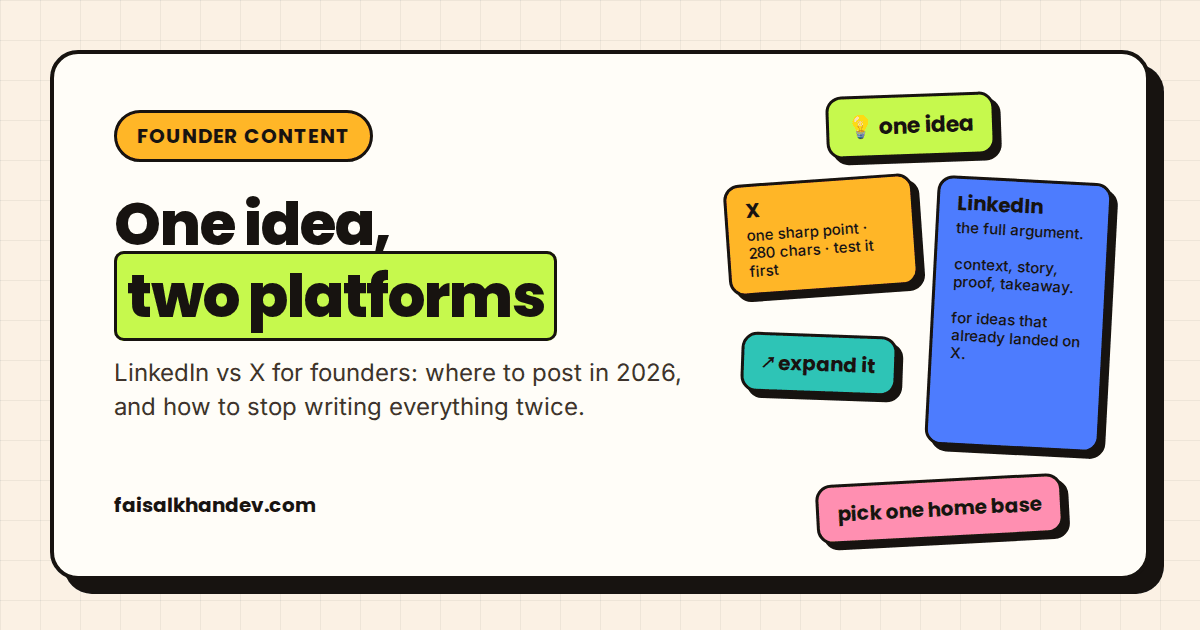
For most B2B founders, LinkedIn is the better home base and X is the better testing ground. LinkedIn reaches a larger professional audience and has room for a full argument, while X rewards one sharp point in 280 characters. Post the short version on X first, then expand the ideas that land into LinkedIn posts.
Below is the data, the trade-offs, and the routine I would use.
What does LinkedIn vs X for founders actually mean?
LinkedIn vs X for founders is the choice between two very different publishing formats: LinkedIn, a professional network built around longer posts with context and story, and X, a fast feed built around short, single-point posts. LinkedIn vs X for founders is really a choice about format and audience, not about which network is bigger.
Most founders do not need to pick only one. They need to know which one gets their best hours.
Is LinkedIn or X bigger? What the data says in 2026
LinkedIn is used by more US adults than X, and X is shrinking slightly while most other platforms grow. The clearest numbers come from Pew Research Center.
- LinkedIn: 32% of US adults said they use it in Pew's 2024 survey, the most recent year LinkedIn appears on the Pew Research Center social media fact sheet, up from 28% in 2021.
- X: 21% of US adults said they use it in a 2025 Pew survey of 5,022 US adults, conducted February 5 to June 18, 2025. X was the one platform in that report whose use fell since 2021, from 23%.
- Only 10% of US adults use X daily, according to a separate Pew survey of 5,123 US adults from February 24 to March 2, 2025, reported in the same 2025 study.
- X skews male. In the same 2025 data, 25% of men said they use X, compared with 16% of women.
Two limits worth knowing: these are US numbers, and they measure people, not buyers. Your customers may sit in a different country or in a niche where one platform dominates. Treat the data as a starting point, not a verdict.
How LinkedIn and X posts differ
LinkedIn and X posts differ mainly in length, and length changes what kind of thinking each one rewards.
LinkedIn's help center sets the post limit at 3,000 characters. That is room for a short essay. In practice the feed shows the first couple of lines and hides the rest behind "see more", so the opening has to earn the click.
X's developer documentation on counting characters puts the limit at 280 characters on a standard post, with every emoji counting as 2. That leaves room for one point. No setup, no story, no list of three lessons.
Here is what I think that means in practice. LinkedIn rewards explanation: what happened, why it matters, what you learned. X rewards commitment: the claim, the number, the question. A founder who is good at one is often uncomfortable with the other, and that discomfort is useful information about where to start.
What founders can post on each platform
The same week of building gives you material for both platforms. It just comes out differently.
Say you changed your pricing. On LinkedIn, that becomes a post about how you decided: the options you weighed, what customers said, what you would do differently. On X, it becomes one line: the new price and the single reason behind it.
Say you shipped a feature. On X, a short post with what it does and who asked for it. On LinkedIn, the story of the customer problem that started it, told in a few short paragraphs.
Say a story in your industry is everywhere this week. On X, your one-sentence take while the conversation is still forming. On LinkedIn, the longer version a day later, with the context your buyers need and what it means for them.
The pattern holds most of the time. X gets the conclusion. LinkedIn gets the reasoning.
Which platform suits which founder
The right platform depends on who buys from you, not on where founders hang out. A simple way to decide is to look at your buyer, your content and your time.
| Your situation | Lean towards | Why |
|---|---|---|
| Selling to companies, managers or agencies | Your buyers are there in a work mindset, and long posts can explain a problem properly | |
| Selling to developers or technical users | X | Developer conversation moves fast and short technical takes travel well |
| Building in public with frequent small updates | X | Short posts suit "shipped this today" updates you would not write 1,000 words about |
| Hiring, partnerships or fundraising | People check LinkedIn profiles before replying, so your posts become your track record | |
| Little time, one platform only | A larger professional audience and posts that stay readable longer than a fast feed | |
| Testing which ideas resonate | X first | One sentence is quick to write and quick to judge before you spend time on a long post |
Why founders stop posting on both
Founders usually stop posting because finding a topic takes longer than writing about it. The first two weeks run on ideas saved up in your head. After that, every morning starts with a blank page and twenty minutes of scrolling.
Posting on two platforms doubles that pressure if you treat them as two separate jobs. It does not have to. The research is the same for both. Only the shape of the post changes.
I ran into this myself, and it is the reason I built TrendPost. It checks live sources in your niche every morning and shows 3–5 topics that are actually being discussed, each with a source link, engagement numbers and age, then drafts posts sized for LinkedIn or X. The AI is not allowed to invent a trend; it only works with what a real source returned. I wrote up how I built that AI content research tool, including the bugs.
How to post on LinkedIn and X without writing everything twice
Write one idea, then shape it twice. This routine takes about twenty minutes a day once it is a habit:
- Pick one current topic. Look where people in your field talk to each other: niche communities, Hacker News, newsletters, trade press. Choose a story from the last few days that is still gathering comments, and keep the link.
- Write your take as one sentence. If you cannot say what you think in one sentence, pick a different topic rather than forcing it.
- Post that sentence on X. Tighten it to fit 280 characters. Add one detail from the source if there is room.
- Expand it on LinkedIn. Use the same sentence as your opening line, then add the context, something only you know from building your company, and one closing question.
- Rotate the angle through the week. A contrarian take, a number from the source, a practical step, an honest question. The variety keeps daily posting from sounding like a template.
- Skip empty days. A forced post teaches people to scroll past you. If you are still building the product you want to talk about, MVP development gets you to something real to show, which makes better posts than opinions alone.
Should a founder post on LinkedIn or X first?
Start with LinkedIn if you sell to companies and have time for one platform, because more US adults use it and longer posts build a track record buyers can read. Start with X if you sell to developers, or use it as a quick testing ground for ideas before expanding them on LinkedIn.
Can I post the same content on LinkedIn and X?
You can share the same idea on both, but not the same text. A full LinkedIn post cut down to 280 characters usually loses its point, and a short X post pasted onto LinkedIn reads like half a thought. Write the one-sentence version for X, then expand that sentence into the LinkedIn post.
How often should a founder post on LinkedIn and X?
Aim for most weekdays on whichever platform is your home base, and skip days with nothing real to say. Consistency over several months matters more than any single week. On X, short posts make near-daily posting realistic; on LinkedIn, three or four strong posts a week is a sustainable pace for most founders.
Is X still worth it for B2B founders in 2026?
X is still worth it for B2B founders whose buyers are technical, such as developers, engineering leaders and other founders. Pew data shows fewer US adults use X than LinkedIn and its share fell slightly since 2021, so for non-technical B2B buyers, LinkedIn usually deserves most of your posting time.
Where to start
LinkedIn vs X for founders comes down to your buyer and your stamina, not to which network is louder. Pick a home base, use the other for short tests, and write one idea twice instead of two ideas once. If you are building a product and want help getting it to the point where it is worth posting about, get in touch.