
AI Agent Development
- Multi-step agents built with LangChain, OpenAI, and tool-calling
- Agents that read your data, decide, and act — not just respond
- MCP and API integrations so agents can reach your real systems
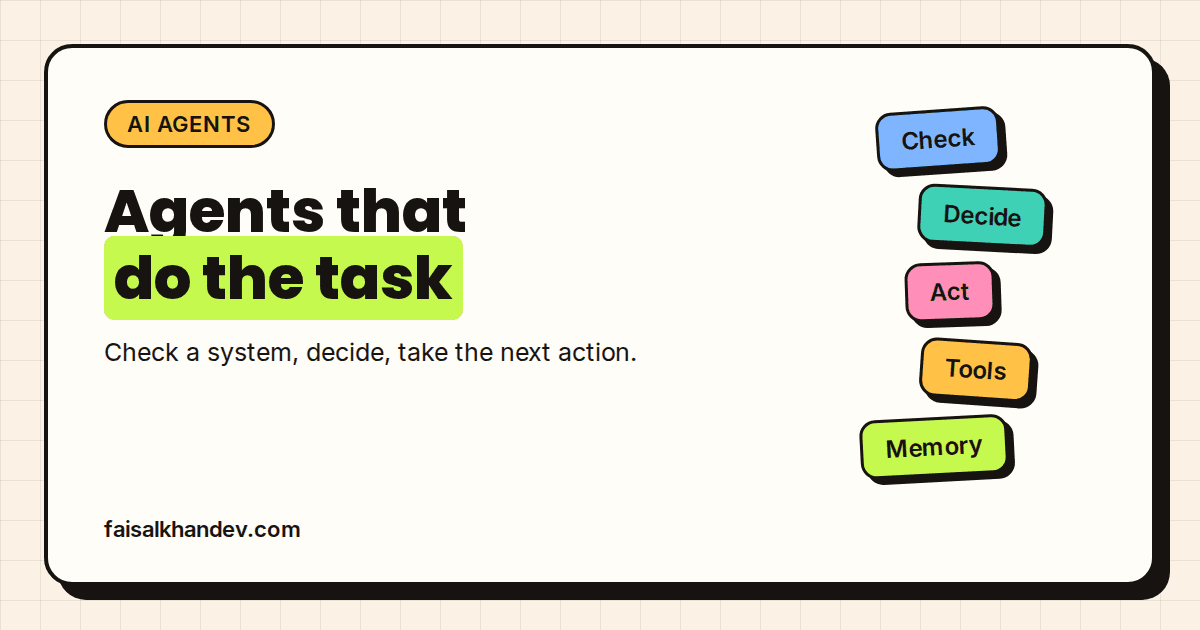
Most "AI agent" products on the market are a chatbot with a system prompt. A real agent has a goal, a set of tools it can call, and the ability to decide what to do next based on what it finds — checking a database, calling an API, sending an update, and knowing when a step failed and needs a retry or a human.
LangChain and the OpenAI API for reasoning and tool-calling, Python for the agent runtime, MCP where the agent needs to reach external tools or data sources, Node.js/NestJS for the surrounding application and APIs.
Agent architecture (what it can decide vs. what needs a human), tool/API wiring, error handling for the cases the agent gets wrong, and a way to actually watch what the agent is doing after launch.
Full Stack AI Development is the whole product — frontend, backend, database, with AI woven in. This service is narrower: one or more agents that plug into a system you already have, or into a new build.
This is about agents that take action inside a real workflow. If the goal is a full product built around AI from the ground up, see Full Stack AI Development instead.
Common questions
What's the difference between an AI agent and a chatbot?
A chatbot answers a question. An agent can check something, decide what to do based on what it finds, and take the next action — calling a tool or API — without a person driving each step.
Can an agent connect to tools I already use?
Yes — through APIs, webhooks, or MCP where supported. Most CRMs, databases, and internal tools with any kind of API can be wired in.
What happens when the agent doesn't know what to do?
Edge cases get routed to a human review step rather than letting the agent guess. That boundary is designed in up front, not discovered after something breaks.
Do you build one agent or a multi-agent system?
Both, depending on the task. Simple workflows use one agent; more complex ones split responsibilities across a few agents that hand off to each other.
Is this only useful for large companies?
No — most projects so far have been a single agent solving one specific, repetitive decision-and-action problem, not a full enterprise rollout.
See also
Best plan offer
Basic
Delivery: 1-2 weeks
- Full-stack website, up to 5 pages
- React/Next.js + Node.js + SQL/MongoDB
- Database integration + API development
- Fully responsive design
Standard
Delivery: 2-4 weeks
- Full-stack website, 5-7 pages
- React/Next.js + Node.js + SQL/MongoDB
- Authentication system (JWT/Auth.js)
- AI features integrated (chat, search, or content)
- Custom UI components
Premium
Delivery: 3-6 weeks
- AI automation / agentic system, built to spec
- Custom agent workflows (LLM-driven, tool-using)
- Integrations with your existing tools/APIs
- Task/process automation to replace manual work
- Admin dashboard + monitoring