
Claude Duet vs ChatGPT Dots vs Meta Muse: Which AI Agent Fits Your Work
By Faisal Khan
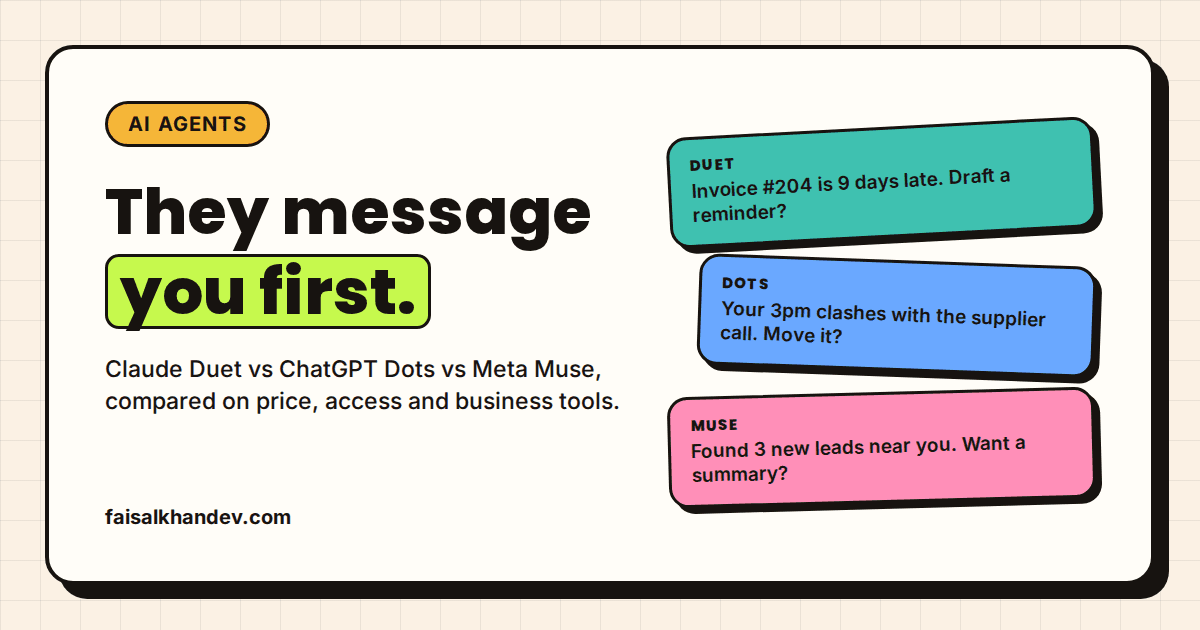
Anthropic was the last of the three to show up. Meta launched its Muse agent app on September 8. OpenAI launched ChatGPT Dots on September 29. Then on October 21, Anthropic opened a waitlist for Claude Duet, an agent that messages you first instead of waiting to be asked.
I build AI agents and automations for small businesses, and Duet is the first of these aimed squarely at that crowd. My take on Claude Duet vs ChatGPT Dots vs Meta Muse: Muse is the cheapest way to try a personal agent, Dots is the one most people can actually use today, and Duet is the best fit for running a small business, if you can get off the waitlist.
I haven't used Claude Duet yet, because it's waitlist-only. Everything about it below comes from Anthropic's announcement and press coverage, not my own testing.
What are Claude Duet, ChatGPT Dots and Meta Muse?
Claude Duet, ChatGPT Dots and Meta Muse are proactive AI agents from Anthropic, OpenAI and Meta that run on their own cloud computers, connect to your apps, keep working after you step away, and check with you before sending, paying or deleting anything. Claude Duet is the newest, opened as a waitlist preview on October 21, 2026.
All three are agents, not chatbots. A chatbot answers and forgets. These hold a goal, check back on their own, and come to you when something needs a decision. If that line is fuzzy, my AI agent vs chatbot post covers it.
Claude Duet is Anthropic's new standalone app on iOS, Android and claude.ai. In Anthropic's launch post, the company says it built Duet "for professionals and small business owners with more on their plates than they can track."
ChatGPT Dots launched at OpenAI DevDay on September 29, 2026, as TechCrunch reported. Each dot runs on GPT-6 Astra and connects to more than 4,000 apps through plugins. I've compared Dots twice already, against Grok Bot and against Copilot Autopilot.
Meta Muse is Meta's personal agent app, launched September 8. CNBC's launch report quotes Meta AI chief Alexandr Wang saying it runs in "its own isolated environment" and "never sees your actual passwords or payment details." Since October, Muse subscribers get Meta's new Muse Wonder model, which I compared in Muse Wonder vs Claude Opus 5.5 vs Gemini 4 Argon.
How does Claude Duet work?
Claude Duet works by checking your connected apps every few hours, sending you a short brief each morning, and messaging you only when something needs your attention. It carries over the memory, skills and connected apps from your existing Claude account, so there's very little setup.
The details in Anthropic's post are more specific than most launch posts, which I appreciate. Duet has its own virtual machine with a browser, so your laptop and phone can be off while it works. You talk to it by typing or voice in one ongoing thread.
The "every few hours" part is a deliberate trade-off. Anthropic says checking nonstop "would use up your plan's limits much faster." So an urgent email can sit for a while before Duet notices it. That's fine for invoices. It's not fine for a customer whose order just went wrong.
The approval rules are clear. Duet reads, drafts and prepares work by itself. Before it sends a message, makes a payment, signs a document or deletes anything, it shows you exactly what it's about to do and waits. Some things are off-limits even if you say yes, like trading securities or moving money between accounts.
What caught my eye are the examples. Anthropic doesn't lead with booking dinner. It leads with chasing unpaid invoices in QuickBooks or Stripe, preparing payroll in Gusto, drafting HubSpot follow-ups and managing a Shopify store. Duet can reach over 6,000 connectors and plugins in the Claude Marketplace. One early tester, a restaurant owner with about 110 employees, used it for accounting, customer support and marketing.
Anthropic is also honest about the gaps. Duet "might misread a thread or miscalibrate what's urgent," personal errands like booking tickets aren't as strong, and you can't yet watch its browser.
How are ChatGPT Dots and Meta Muse different?
ChatGPT Dots and Meta Muse differ from Claude Duet mainly in who they're built for. Dots targets professionals and teams who already pay for ChatGPT, and lives inside ChatGPT, Slack and Teams. Muse targets everyone, starting free, with consumer jobs like shopping deals sitting next to small business ones.
Dots is the most "work colleague" of the three. You message your dot in ChatGPT, Slack or Microsoft Teams, per Tom's Guide. It learns your preferences from feedback, and Custom Rules let you decide which actions it takes alone, which need approval, and which are blocked.
Muse is the mass-market play. It topped Apple's App Store after launch, and Meta pitches it to consumers and small businesses for tasks like "organizing personal emails, searching for shopping deals or seeking out prospective customers," per CNBC's October follow-up. The same piece says the open question for Meta is trust. That's fair. A lot of small business owners will hesitate before connecting their books to a Meta app.
Honestly, these products are converging fast. All three run in the cloud, all three ask before risky actions, and all three want to be the first thing you check in the morning. The real differences are price, who can get in, and which business tools each one connects to well.
Claude Duet vs ChatGPT Dots vs Meta Muse: side-by-side
Claude Duet has the strongest small business tooling but sits behind a US waitlist, ChatGPT Dots is available now at the highest entry price, and Meta Muse is the cheapest to try with its free tier. Here's the comparison on the points that decide which one you'd actually pay for.
| Claude Duet | ChatGPT Dots | Meta Muse | |
|---|---|---|---|
| Maker | Anthropic | OpenAI | Meta |
| Launched | October 21, 2026 (preview) | September 29, 2026 | September 8, 2026 |
| Can you use it today? | Waitlist, US Pro, Max and Ultra only | Yes, Pro and Business Premium | Yes, including a free tier |
| Cheapest way in | Claude Pro, $20/month | ChatGPT Pro, from $100/month | Free |
| Model behind it | Claude Opus 5.5 | GPT-6 Astra | Muse Wonder (paid plans) |
| App connections | 6,000+ connectors and plugins | 4,000+ plugins | Apps you already use |
| Best fit | Small business admin: invoices, payroll, CRM, store | Teams already living in ChatGPT, Slack or Teams | Trying a personal agent without paying |
How much do Claude Duet, Dots and Muse cost?
Claude Duet costs nothing extra during its research preview: it's included in Claude Pro, Max and Ultra and shares those plans' usage limits. ChatGPT Dots includes your first dot in ChatGPT Pro, which starts at $100 a month. Meta Muse is free, with paid plans at $20 or $100 a month depending on usage.
For Claude, the pricing page lists Pro at $20 a month ($17 billed annually), Max at $100 and Ultra at $200. The catch is that Duet's background checks count toward your limits, and Anthropic says bigger jobs like a financial model or a deck take more model turns. On Pro, a busy Duet could eat into the Claude you use for everything else. Anthropic hasn't said what Duet will cost after the preview.
For Dots, I covered the Pro and Business Premium seat prices in my Grok Bot vs ChatGPT Dots post. Dots conversations don't count toward your normal ChatGPT limits, which is a nice touch.
Muse's paid plans are priced by tokens, a measure of how much AI work the agent does, per CNBC. Free is free, but a heavy user will hit the meter. Paying also unlocks the Muse Wonder model, CNBC reported.
So the cheapest real setup for a small business owner is Claude Pro at $20, if you get in. Dots costs five times that to start.
Which one is safest with business data?
Claude Duet has published the most detail about safety so far, including a classifier that checks each message and refuses to share credit card numbers or government ID. ChatGPT Dots and Meta Muse both say they ask before sensitive actions. None of the three has independent security testing you can read yet.
Anthropic says Duet never directly sees your passwords or sign-in tokens, and that red teams and an outside firm penetration tested it. Health and personal finance details only get sent when you explicitly tell it to. Meta makes a similar password claim for Muse. Dots leans on its Custom Rules.
All of this still has one weak spot: prompt injection. An agent that reads your inbox can be steered by whatever lands in that inbox, including a cleverly worded supplier email. I go into how that goes wrong in what can go wrong with AI agents. My rule for clients is simple. Keep the approval step on for anything that leaves the building, at least for the first month.
How to choose between Claude Duet, Dots and Muse
Choose based on what you need the agent to touch, how much you'll pay to start, and whether you can wait for a waitlist. Six steps cover it.
- List the five tasks that eat your week. Invoices, follow-ups, scheduling, payroll, store updates. Be specific, because each agent is strongest on different tools.
- Check which agent connects to those tools. If your business runs on QuickBooks, Gusto, HubSpot or Shopify, Duet's launch examples read like your list.
- Join the Duet waitlist now if you're in the US. It costs nothing on a Claude plan you may already have, and the queue only gets longer.
- Try Muse free in the meantime. It's the lowest-risk way to learn what a proactive agent is actually good for before paying.
- Pick Dots if your team already lives in ChatGPT, Slack or Teams. It's available today, and the $100 entry price is easier to justify across a team than for one person.
- Give it one boring task for a month. Measure time saved before you hand it anything customer-facing.
One thing all three share: they act on behalf of one person. That's fine for an owner's inbox. It's the wrong shape for a process the business depends on, like syncing orders between your store and your stock system, or sending reorder alerts every morning. That kind of work is AI automation: it runs on a schedule, on your own systems, with nobody's seat attached. When it needs judgment as well, it's a custom AI agent with its own logs and permissions.
Is Claude Duet better than ChatGPT Dots?
Claude Duet looks better than ChatGPT Dots for small business owners, because it ships with examples for QuickBooks, Gusto, Stripe and Shopify and starts on a $20 plan. ChatGPT Dots is better if you need an agent today, since Duet is a US-only waitlist preview and Dots is already live.
Can I get Claude Duet now?
Claude Duet is available by waitlist only, as a research preview for Claude Pro, Max and Ultra subscribers in the US. Anthropic emails people when their access is ready. Team and Enterprise plans are not included yet, and Anthropic has not given a date for wider access.
Is Meta Muse really free?
Meta Muse has a genuinely free tier, and Meta also sells paid plans at $20 or $100 a month based on how much AI work you use. Access to Meta's newer Muse Wonder model requires one of the paid plans, and Meta says its strongest safeguards come only with that paid model for now.
Can these AI agents spend money for me?
Claude Duet can buy things for your business through Link, Stripe's digital wallet, but it confirms the item with you and Link asks you to approve the spend. It then pays with a virtual card. Duet will not trade securities or move money between accounts, even with your approval.
Where to start
Claude Duet vs ChatGPT Dots vs Meta Muse comes down to timing and tools: Muse to try for free, Dots to use today, Duet to run a small business once you're in. Start with one repeated task and measure it. If the job turns out to be a whole business process rather than one person's chores, let's talk about building it properly.