
GPT-6.1 Sol vs GPT-6 Astra: Which Model Should Your AI Feature Run On?
By Faisal Khan
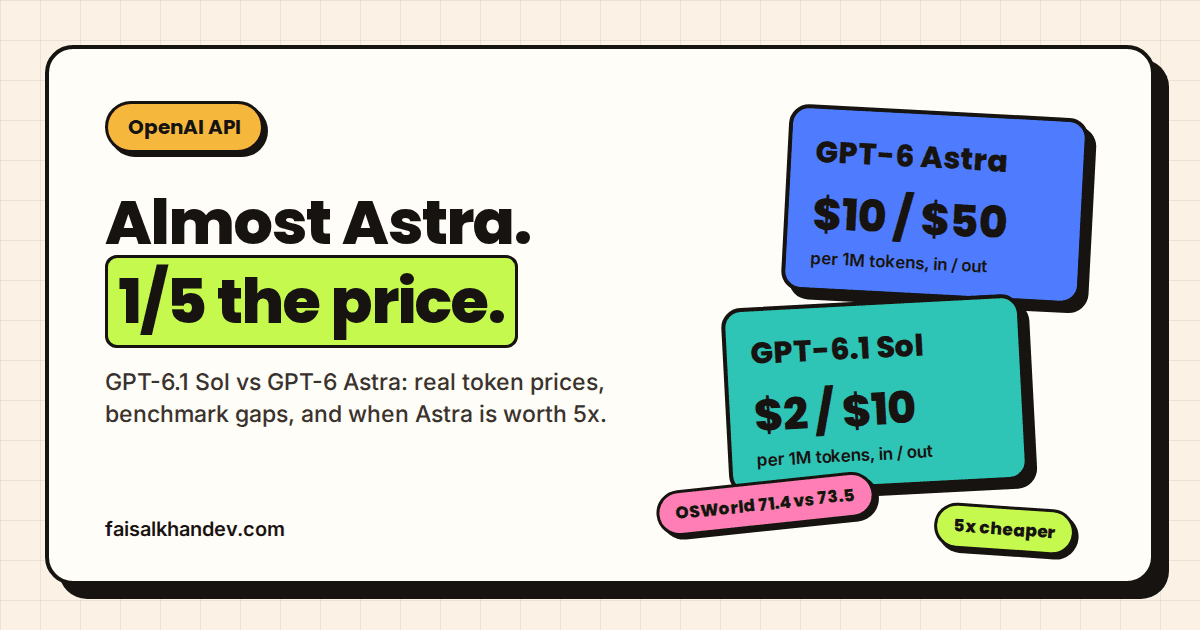
A week after shipping GPT-6 Sol, OpenAI replaced it. GPT-6.1 Sol arrived at DevDay on September 29 with a bold claim: close to GPT-6 Astra on coding and computer use, at one-fifth of the token price.
If you run an AI feature in production, the obvious question is whether to switch.
Here's my answer on GPT-6.1 Sol vs GPT-6 Astra: for most AI features, Sol is now the default and Astra is the exception you justify with a test. The benchmark gap is a few points. The price gap is 5x. You only pay that gap where a few points of quality turn into real money.
What are GPT-6.1 Sol and GPT-6 Astra?
GPT-6.1 Sol and GPT-6 Astra are OpenAI's two top API models as of October 2026. GPT-6 Astra is the flagship model built for the hardest end-to-end work. GPT-6.1 Sol is the cheaper high-end model, released September 29, 2026, that OpenAI says comes close to GPT-6 Astra on coding, computer use, and professional tasks.
The naming confuses people, so here's the family in plain terms. Astra is the top tier. Sol sits below it. Luna is the fast, cheap tier below that, per OpenRouter's OpenAI model list. The ".1" on Sol matters: it's a different, better model than the original GPT-6 Sol, not a minor patch.
One more detail from TechCrunch's DevDay report: OpenAI did not ship a GPT-6.1 Astra, which many expected. So for now, Astra is still on its September version, and the newer model is the cheaper one. That rarely happens.
How close is GPT-6.1 Sol to GPT-6 Astra in 2026?
GPT-6.1 Sol is close to GPT-6 Astra on most published tests, but not equal. On OpenAI's numbers, the gap is usually a few percentage points, and Sol gets there at a fraction of the cost per task.
The key figures, all from OpenAI's launch announcement as posted in the OpenAI Developer Community on September 30, 2026:
- OSWorld 2.0 (computer use): Sol scores 71.4% versus Astra's 73.5%, both at maximum effort, at roughly one-seventh of Astra's cost per task.
- DeepSWE v1.1 (software engineering): Sol hits 75.2% at high effort, beating the old GPT-6 Sol's best of 68.8%, at about 76% lower cost per task.
- AutomationBench: Sol scores 31.7% at medium effort, up 4.8 points on GPT-6 Sol.
On accuracy, TechCrunch reports OpenAI's claim that Sol's factual error rate stays within 1.9 points of Astra across reasoning settings. Independent testing on Astra is also worth a look. Artificial Analysis found Astra tied for first on its Intelligence Index in September 2026, so the model Sol is chasing is genuinely top tier.
A caution I give every client: these are vendor benchmarks. They're useful for a shortlist. They don't tell you how either model handles your messy PDFs or your odd customer questions.
GPT-6.1 Sol vs GPT-6 Astra pricing: what each costs
GPT-6.1 Sol costs $2 per million input tokens and $10 per million output tokens on the standard API tier. GPT-6 Astra costs $10 per million input tokens and $50 per million output tokens. Astra is five times the price on both sides.
Cached input changes the picture a little. Sol's cached input is $0.10 per million, cut from $0.20 on the old GPT-6 Sol. Astra's cache reads cost $1 per million, a 90% discount, with a 25% premium on cache writes, per Artificial Analysis. OpenRouter also lists an OpenAI Flex tier for Astra at $5 and $25 if you can wait for slower responses.
Here's what that means for a real feature. In my post on what it costs to run an AI feature in production, I used a typical support-assistant request: about 5,100 input tokens and 400 output tokens.
| GPT-6.1 Sol | GPT-6 Astra | |
|---|---|---|
| Input price (per 1M tokens) | $2 | $10 |
| Output price (per 1M tokens) | $10 | $50 |
| Cached input (per 1M tokens) | $0.10 | $1 |
| One support request (5,100 in / 400 out) | about 1.4 cents | about 7.1 cents |
| 30,000 requests a month, no caching | about $426 | about $2,130 |
| Best fit | High-volume features, most coding agents | Long, high-stakes tasks where errors are expensive |
The last two rows are my own arithmetic from the list prices, before caching. With prompt caching on a static system prompt, both numbers drop, but the 5x ratio stays.
Why cost per task matters more than cost per token
Cost per task is the number that decides your bill, because a model that finishes in fewer steps can be cheaper even at a higher token price. That's why OpenAI's "one-seventh the cost per task" on OSWorld is bigger than the 5x token gap.
Agentic work, like a coding agent or a computer-use flow, runs in loops. The model thinks, acts, checks, and tries again. Every loop adds output tokens, and reasoning tokens bill as output. A model that wanders burns money.
Astra has an argument here. Artificial Analysis found Astra sits on the token-efficiency frontier at every reasoning level, meaning it tends to use fewer output tokens for the score it gets. So on some long tasks, Astra's real cost per task will be well under 5x Sol's.
Honestly, this is where I'd stop trusting any blog post, including mine, and measure. Log tokens per completed task for both models on your own workload. That's the only number that matters.
How to choose between GPT-6.1 Sol and GPT-6 Astra
Choose GPT-6.1 Sol by default and move to GPT-6 Astra only where your own tests show a quality gap that costs more than the price difference. These are the steps I'd follow.
- List every model call in your app. Chat replies, extraction, summaries, agent steps. Most apps have four to ten distinct calls, and they don't all need the same model.
- Collect 50–100 real requests per call. Pull them from logs, with personal data removed. Synthetic test prompts flatter every model.
- Run both models on the same set. Score answers against what a good answer looks like, and record tokens and time per request.
- Put a price on a wrong answer. A bad support reply might cost a follow-up email. A bad contract summary might cost a client. That number decides whether Astra pays for itself.
- Route by task, not by app. Send routine calls to Sol and the rare high-stakes ones to Astra. One model for everything is a common, expensive mistake.
- Re-test every quarter. OpenAI replaced Sol within a week. Pricing and rankings move fast, so the right answer today may change by January.
This kind of routing and evaluation is a big part of how I approach AI integration in existing apps. Picking the model is a ten-minute decision. Measuring it properly is what saves the money.
Is GPT-6.1 Sol better than GPT-6 Astra?
GPT-6.1 Sol is not better than GPT-6 Astra on raw quality, since Astra still scores slightly higher on OpenAI's coding and computer-use benchmarks. GPT-6.1 Sol is better value for most AI features, because it gets within a few points of Astra at one-fifth of the price per token.
Is GPT-6.1 Sol good enough for coding agents?
GPT-6.1 Sol is good enough for most coding agents. OpenAI reports it scores 75.2 percent on DeepSWE v1.1 at high reasoning effort, well above the original GPT-6 Sol. Teams running long, unsupervised refactors across large codebases may still prefer GPT-6 Astra for fewer failed attempts.
Should I switch my app from GPT-6 Sol to GPT-6.1 Sol?
Most apps should switch from GPT-6 Sol to GPT-6.1 Sol, because it keeps the same two and ten dollar per million token prices while scoring higher and halving the cached input price. Test it on your real requests first, then change the model name in your API calls.
When is GPT-6 Astra worth the extra cost?
GPT-6 Astra is worth the extra cost when a wrong answer is expensive and the task is long or complex, such as legal or financial document review, multi-hour agent runs, or security work. For high-volume features like chat or support, the five times higher price is rarely justified.
Where to start
GPT-6.1 Sol vs GPT-6 Astra comes down to one rule: start on Sol, prove where Astra earns its price, and route only those calls to it. The common mistake is paying for the flagship out of caution, not evidence. If you want help testing your own workload or cutting an AI bill, get in touch.