
Industrial ERP Platform
- Client
- Industrial Lubricants & Oils Distributor
- Duration
- Ongoing / Production
- Built with
- NestJS, Next.js 14, TypeScript, PostgreSQL, Prisma, Supabase, Stripe, EasyPost, Resend, OpenAI API
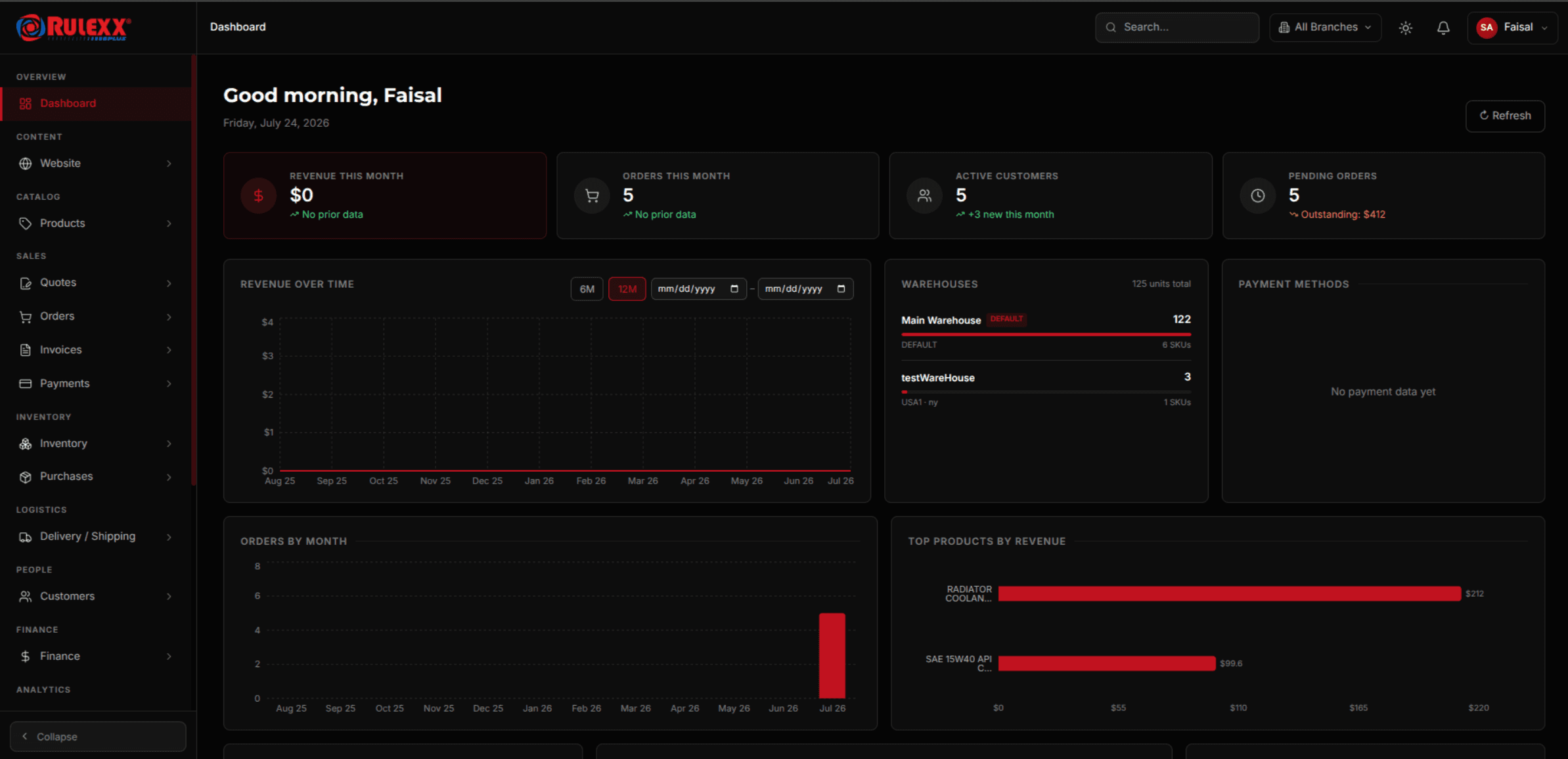
An AI ERP platform is an enterprise resource planning system with AI built into the workflow itself — not a chatbot bolted onto a traditional ERP, but automation and an AI assistant woven through inventory, procurement, and finance from the start. This one was built for an industrial lubricants and oils distributor, spanning the public storefront customers order from, the admin dashboard staff run the business on, and the backend API tying it all together. Reorder points trigger purchase orders on their own, every financial transaction posts its own accounting entries, transactional emails fire automatically off business events, and an internal AI chatbot answers stock questions straight from live ERP data.
Available as a product for other distributors
The system described here is now offered as a scoped build for other process-distribution businesses — chemical, paint and coatings, adhesive, and lubricant distributors — under Distributor ERP. The inventory, procurement, blending, dealer-pricing, and finance modules already exist and run in production, so a new engagement is about adapting them to a different operation rather than building an ERP from scratch. For the build-versus-buy reasoning against Datacor, BatchMaster, SAP, NetSuite, and Odoo, see custom ERP for chemical and paint distributors.
Architecture
Three independently deployed services sharing one PostgreSQL database via Prisma:
- Backend (NestJS) — REST API, JWT auth, role-based access control (Super Admin / Staff)
- Admin Dashboard (Next.js) — staff-facing ERP console, installable as a PWA
- Public Website (Next.js, App Router) — customer storefront with Server Components
Core capabilities
- Inventory & Warehousing — multi-warehouse stock tracking, stock transfers, batch/expiry tracking with QC alerts, production/blending orders that convert raw materials into finished goods
- Procurement Automation — supplier management, RFQ-to-purchase-order workflow, automated reorder-point replenishment (MRP-lite) that watches stock levels and one-click generates draft purchase orders, vendor bills (AP)
- Sales & Orders — guest checkout, quote requests, customer groups with tiered pricing rules, credit limit/hold enforcement, returns/RMA workflow linked to credit notes and restocking
- Fulfillment — dispatch orders, in-house delivery driver assignment, multi-carrier shipping labels and tracking via EasyPost
- Finance Automation — double-entry bookkeeping engine that auto-posts journal entries on every order, payment, credit note, and bill, budgets with variance reporting, financial statements
- Internal AI Chatbot — staff-facing assistant answering inventory and stock questions directly against the ERP's live data, no manual report-pulling needed
- Operations — full audit log across every module, automated transactional email (Resend) with per-event throttling, analytics dashboard (revenue, top products, payment aging)
- Storefront extras — blog/CMS, distributor lead-gen forms, supplier self-service portal, Stripe payments
Engineering notes
- Strict TypeScript across all three services, Zod + react-hook-form for every form
- CI pipeline (GitHub Actions) auto-builds and commits backend production output on push
- Sentry error monitoring, Next.js Image optimization throughout, mobile-first responsive design
What makes an ERP platform an "AI ERP" rather than a traditional one?
Automation and AI woven into the core workflow, not added as a side panel. This platform generates purchase orders automatically at reorder points, posts accounting entries on its own for every transaction, and answers staff questions about live stock data through an AI chatbot — a traditional ERP would require a human to do all three by hand.
Can an AI chatbot safely answer questions from live ERP data?
Yes, when it's scoped to read-only queries against real data rather than generating answers from a general model. This platform's internal chatbot answers inventory and stock questions directly against the ERP's live database, so staff get accurate current numbers instead of a stale report or a guess.
Does AI automation in an ERP replace manual approval on financial transactions?
No — automation handles the repetitive posting, not the judgment calls. The double-entry bookkeeping engine auto-posts journal entries on every order, payment, credit note, and bill, but credit limits, holds, and RFQ-to-purchase-order decisions still route through role-based staff approval.
What does an AI-driven procurement workflow look like in an ERP?
Reorder-point automation (MRP-lite) watches live stock levels and one-click generates draft purchase orders the moment inventory drops below threshold, instead of a staff member manually checking stock sheets and writing POs by hand.