
AI Parent-Doctor Kid Care Platform
- Client
- Pediatric Healthcare Platform (Italy)
- Duration
- Ongoing / Production
- Built with
- Next.js, TypeScript, FHIR, OpenAI API, AWS Bedrock, Node.js
- Live site
- Visit site (opens in new tab)
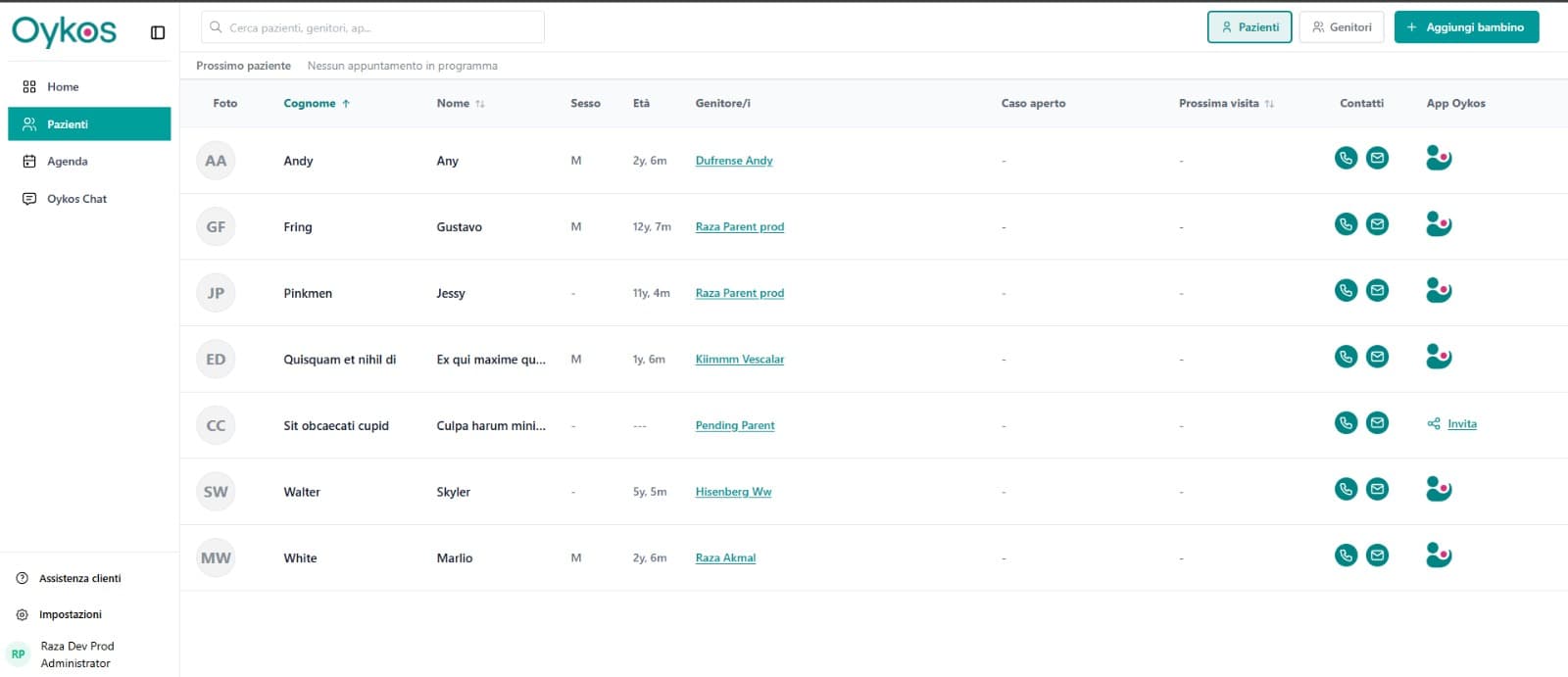
An AI doctor platform is software that lets a patient (or a patient's parent) describe symptoms in plain language and has AI triage the case — sorting urgent from routine — before a real doctor ever sees it. This one was built for an Italian pediatric healthcare provider: parents describe their kid's symptoms in plain language, an AI assistant asks smart follow-up questions, decides how urgent it is, and hands the doctor a clean structured summary instead of a raw chat log. Think of it as a triage nurse that never sleeps: it doesn't diagnose or prescribe anything itself, it just makes sure the right case reaches the doctor fast, with the right context attached. The same assistant also handles the routine stuff — booking vaccines, requesting prescriptions and certificates, and general parenting advice on sleep, food, and behavior.
Architecture
Two connected apps built on FHIR, the healthcare-data standard, so the system stays compatible with real medical record systems doctors already use:
- Parent Portal — chat interface where a parent describes what's going on ("Marco ha la febbre alta"); the AI reads intent, builds a structured case, and routes it to the right doctor
- Doctor-facing backend — doctors are modeled as FHIR
Practitionerresources; triage cases land as structured FHIRCommunicationrecords with symptoms already extracted, not raw chat text - All AI calls forced through an EU OpenAI endpoint — GDPR compliance for healthcare data under Italian regulation
The AI pipeline, end to end
- Router model — first stop for every message: classifies it as triage, general advice, casual chat, a clarification, or a feature request
- Triage model — extracts the actual symptoms from a parent's own words and matches them against an approved symptom list, so the doctor gets structured data, not free text
- Advisor model — answers non-urgent parenting questions (sleep, food, behavior) with a hard rule: never diagnose, never prescribe
- Casual model — handles small talk and greetings without pulling in the heavier triage machinery
- Explainer model — translates medical terms back into plain language for the parent
- Function-calling (
tool_choice) forces every model to return structured JSON, not free-form text that has to be parsed after the fact - AWS Bedrock runs alongside OpenAI as a secondary provider, so a single vendor outage doesn't take the assistant down
- Safety net — a regex layer scans every message for illness keywords before and after the AI call; if the model misses something like "sta male" (kid is sick), the system force-overrides to triage. The AI never gets the final say on medical urgency alone
Doctor-side context
Beyond routing the current case, the AI also builds a health summary of the child's history — past cases, patterns, allergies — so a doctor opens a case already knowing the background, the same way a nurse pre-screens a call before handing it off.
Engineering notes
- Multiple fine-tuned OpenAI models, each scoped to one job, rather than one general-purpose prompt trying to do everything
- Hard safety rails sit outside the model, not just in the prompt — regex keyword checks run independently of what the AI decides
- FHIR resource modeling (
Practitioner,Communication) keeps the system interoperable with external medical record systems rather than inventing a proprietary schema
What makes an AI doctor platform safe to actually use?
An AI doctor platform is safe when the AI never gets the final word on medical urgency. This one runs a keyword-based safety net independently of the model, forces every diagnosis-adjacent question back to "contact your doctor," and routes every case through a licensed pediatrician before any action is taken — the AI narrows and structures, it never decides.
How does an AI triage assistant avoid missing an emergency?
By not trusting the model alone. This platform runs a regex layer that scans every parent message for illness keywords both before and after the AI call — if the model's classification disagrees with an obvious keyword match (like "sta male," Italian for "feeling sick"), the system force-overrides to urgent triage rather than deferring to the AI's judgment.
Can an AI healthcare platform stay compliant with medical data regulations?
Yes, if it's built on the right standards from day one. This platform models every doctor and case using FHIR, the healthcare-data interoperability standard, and routes all AI calls through an EU-based OpenAI endpoint specifically to keep patient data under GDPR and Italian healthcare regulation rather than a US default.
Does an AI triage platform replace the doctor?
No — it filters and organizes for the doctor, it doesn't replace them. The AI never diagnoses or prescribes; it classifies urgency, extracts structured symptoms, and builds case history so the doctor spends their time on medical judgment instead of reading raw chat transcripts.